

How To Improve Your Performance by 44% in Just 10 Weeks*
Scientifically backed. 100% money back guarantee. *Terms and Conditions Apply.

You might be surprised by the headline of this article, but the data is there! Look at the charts below.
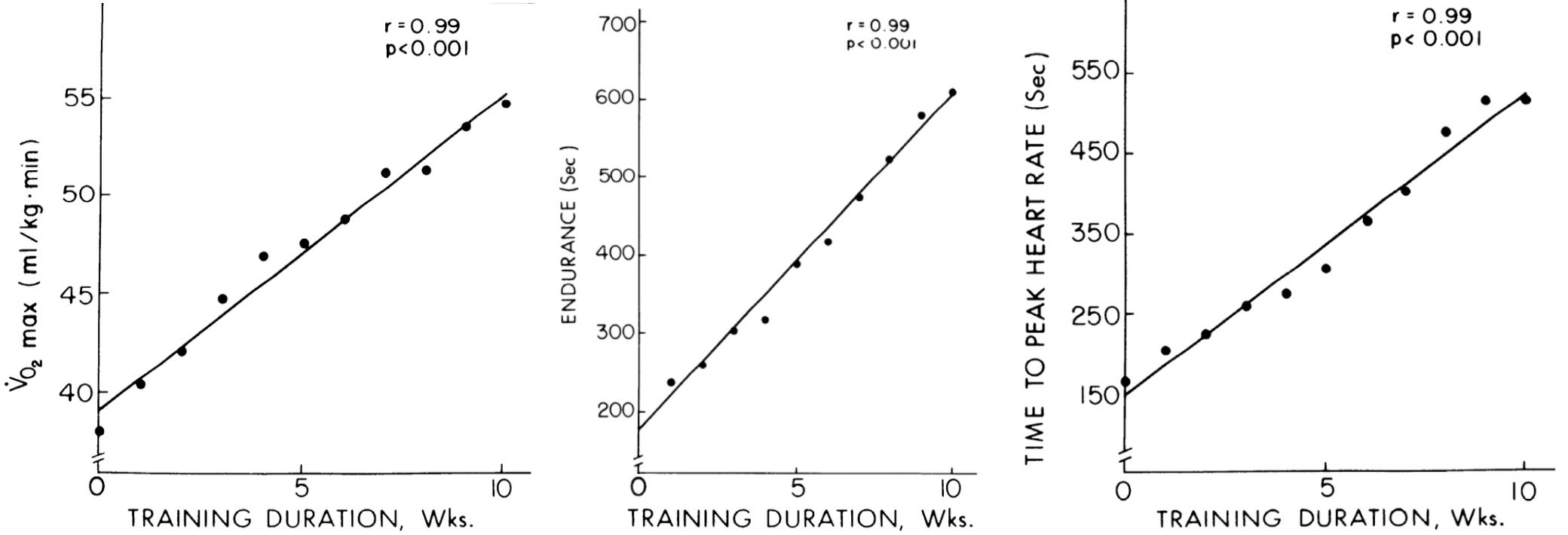
What you are seeing are the results of a landmark study by Hickson et al. (1977), where participants improved their VO2max by a staggering 44% in just 10 weeks of training [1]. Furthermore, their endurance, defined as the time they could sustain their maximum intensity, increased threefold, and their time to reach peak heart rate increased by 3.5 times. There is arguably no other documented training protocol in the world that produces such aggressive, linear results in such a short window.
You might assume these participants were genetic outliers or that the training plan was incredibly complex, but that is not the case. The subjects were aged between 20 and 42, with backgrounds ranging from completely sedentary to moderate endurance exercise three times a week. They weren’t elites; they were people like you.
The training protocol was incredibly simple. Participants trained six times a week for 10 weeks. On three alternating days, they performed an indoor cycling session consisting of six 5-minute intervals. The resistance was adjusted specifically so that each subject attained their VO2max during the 5-minute work period. These bouts were separated by only 2 minutes of recovery at 50-60% of VO2max. As their fitness improved, the resistance was increased to ensure they stayed at that maximal aerobic ceiling.
On the other three days, participants were asked to run as fast as possible for 30 minutes a day during the first week, 35 minutes in the second, and 40 minutes or longer thereafter.
Total volume was roughly five hours a week, significantly less time than most amateur ultra runners spend on the trails, yet the participants' progression was incredible. This study shows that VO2max training improves performance in a perfectly linear fashion. Even after 10 weeks, the improvements showed no sign of tapering off, suggesting that if you simply stayed the course, the gains could continue.
However, if the brutality of this intensity-based protocol doesn’t appeal to you, perhaps you might be tempted by a protocol adopted by most elite athletes across multiple endurance sports.
Good Enough For Them, Good Enough For Me
What do French, Portuguese, and Kenyan elite marathon runners have in common with world-class rowers from Germany, Denmark, the Netherlands and Norway? Their success is built on the Polarised Training Model.
This methodology dictates that roughly 80% of training sessions are performed at an intensity below the first lactate threshold (LT1). The remaining 20% are performed at high intensity, usually above the second lactate threshold (LT2). In a standard three-zone model, this means athletes almost entirely avoid the “middle ground” of Zone 2 [2]. This pattern has also been observed across junior world-class rowers, professional road cyclists, and elite junior Norwegian cross-country skiers [3].
The research, famously championed by Dr Stephen Seiler, found that regardless of the discipline, elite athletes consistently converge on this ~80/20 distribution. The logic is that elite performance requires maximising adaptation while minimising the risk of overtraining and injury.
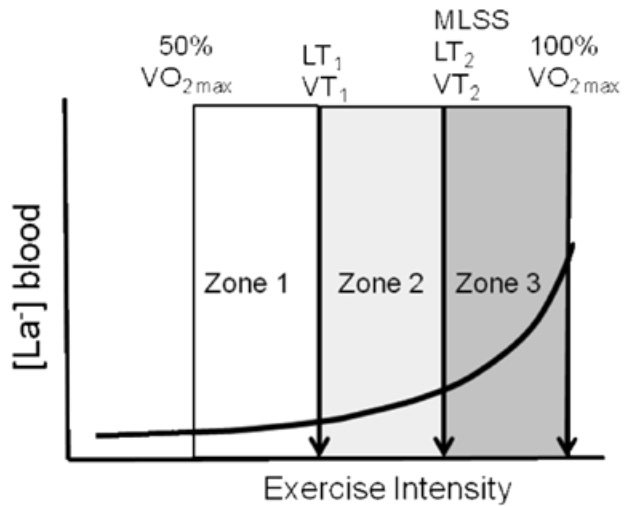
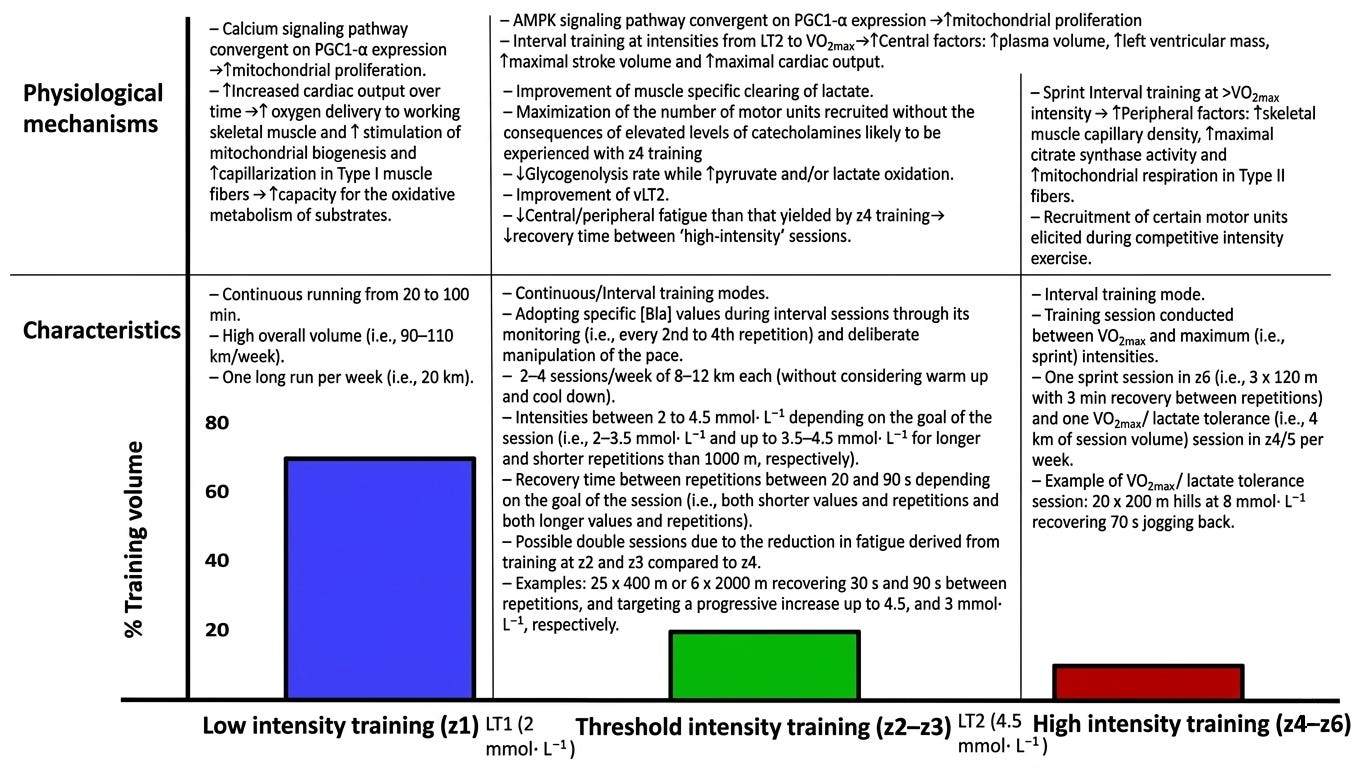
Large volumes of low-intensity training (Zone 1) provide a potent stimulus for peripheral adaptations. These include increased capillary density, literally building more “roads” to deliver oxygen to the muscles, and mitochondrial expansion. Since this type of training induces a very low autonomic load, it can be done frequently, even twice a day.
Conversely, high-intensity work (Zone 3) is required to drive central cardiovascular adaptations, such as increased stroke volume, defined as the amount of blood the heart pumps per beat. However, these sessions cause significant stress to the nervous system. By keeping 80% of sessions easy, athletes remain “fresh” enough to ensure the hard 20% are of a high enough quality to trigger that central signal.
Dr Seiler notes that recreational athletes often fail because they train too hard on easy days, drifting into the “threshold” zone. This intensity is a physiological “no-man’s land,” too hard to allow for high volume, but not hard enough to provide the same adaptation signal as Zone 3. This polarised methodology suggests that by strictly separating these intensities, you will see significantly greater race-time improvements.
But what if the most “trainable” quality isn’t actually at the extremes? What if the secret to the world’s best runner lies right in that middle ground?
Critical Power is “One of the Most Trainable Qualities an Athlete Can Have”
Elite ultra running coach Scott Johnston recently highlighted that critical power, often described as the velocity at the second lactate threshold, is “one of the most trainable qualities an athlete can have” [4]. To optimise it, he suggests a focus on the area between the two thresholds (Zone 2 in a 3-zone model). To see this in practice, we look to Jakob Ingebrigtsen.
Jakob Ingebrigtsen holds the world record for the 1500 metres, mile, 2000 metres, 3000 metres, and two miles. He also has two Olympic gold medals in the 1500 metres and the 5000 metres, along with multiple world and European championships. His success is attributed to “Double Threshold” training, a specific application of Lactate-Guided Threshold Interval Training (LGTIT) [5, 6].
Although these athletes maintain a high volume (120–180 km per week), 75–80% of this volume is done at low intensity (Zone 1), with one weekly high intensity session (above LT2). However, the “Double Threshold” name is derived from an unusual methodology where athletes perform two threshold sessions on the same day, multiple times a week. Unlike training "by feel," this model relies on constant blood lactate monitoring (usually between 2.0 and 4.5 mmol/L) to ensure the athlete stays exactly within the target metabolic window.
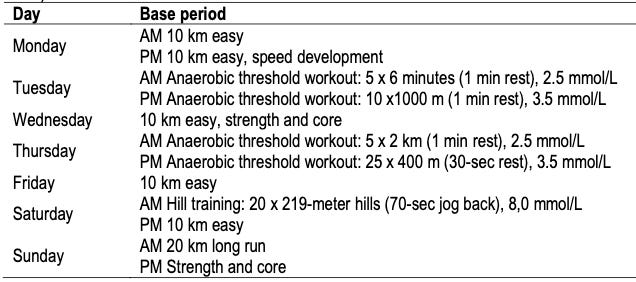
The logic is to maximise the “adaptive signal” while minimising “homeostatic disturbance.” By keeping the intensity precisely at the threshold, athletes can accumulate a staggering weekly volume of “quality” work, often 40-50 km of threshold intervals. This would be practically impossible if the sessions were performed at higher intensities. This is because training just below LT2/Critical Power generates significantly less peripheral and central fatigue, reportedly four to five times less than training just above it.
Using an interval format (e.g., 5 x 2000m) allows the athlete to maintain a higher absolute running speed, recruiting more motor units and improving running economy without the catastrophic fatigue associated with maximal efforts. The speed at the anaerobic threshold is a primary predictor of distance running performance, and by focusing heavily on this marker, athletes build a robust aerobic engine that supports faster racing speeds over any distance.
Omission is the Most Powerful Form of Lie
Up to now, I have attempted to sell you on three distinct training methodologies. I hope you felt tempted by the linear gains of Hickson et al., the elite pedigree of the polarised model, or the scientific precision of the Double Threshold.
But unfortunately, I wasn’t being entirely truthful.
I never lied, every fact can be found in the cited literature, but I opted to omit contextual details that makes these interventions look like silver bullets. Scientific literacy isn’t just about reading the results; it’s about understanding the “fine print” that is often left out of the headline.
Take the Hickson study and its 44% linear improvement [1]. What I didn’t mention was the human cost. Of the eight participants, seven chose to quit immediately after the 10 weeks, with only one participant continuing for a further three weeks. They found the frequency and intensity so exhausting and time-consuming that they only finished out of a sense of responsibility to the researchers.
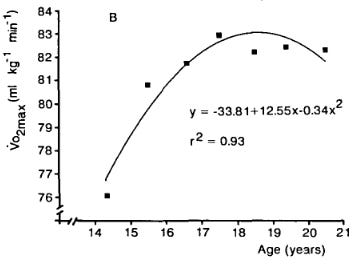
Furthermore, this study was conducted in 1977 on untrained subjects. Modern research in youth athletes and anecdotes from top-tier coaches confirm that while VO2max improvements are significant in the untrained, they diminish drastically as an athlete matures [7, 8]. In fact, it is common for VO2max to peak in an athlete’s late teens or early 20s and remain relatively constant for the rest of their athletic career. For a well-trained ultra runner, the “44% gain” simply does not exist. A plan that you cannot sustain, or that makes you loathe the sport, is a failure, regardless of the physiological signal it sends.
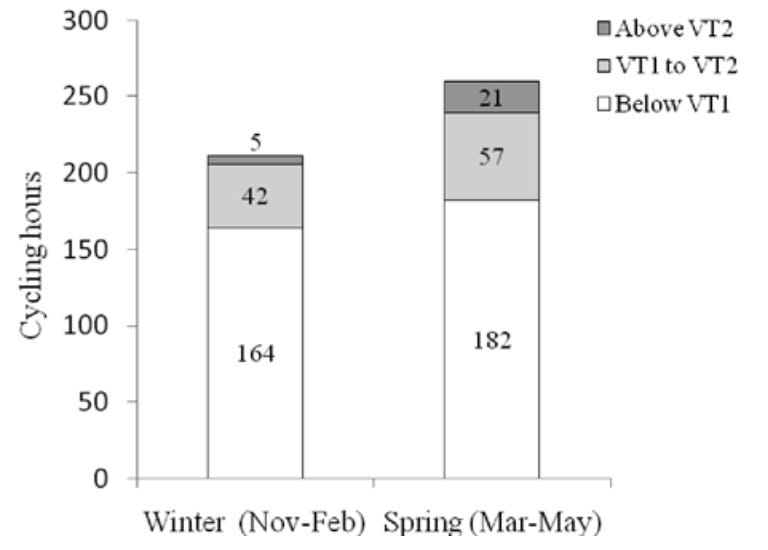
Now, consider the Seiler 80/20 model [2]. The “80% easy” sessions were performed by athletes training 10 to 13 times a week. We are talking about cross-country skiers training 18 hours a week, every week, for a year, and cyclists covering up to 35,000 kilometres a year. For an amateur runner training six hours a week, a strict 80/20 split might mean only one “hard” session every 10 days. Is that enough of a stimulus?
Moreover, Seiler’s data showed that national-class male New Zealand runners spent 4% of their sessions, including racing, at zone 3, while regional- and national-class Spanish distance runners spent 21% in Zone 2 and just 8% in zone 3. The original model didn’t “ban” the middle zone; it highlighted that within each session, elites opt to scope the session, be it a hard-intensity session, a slow long run, or a recovery session. The take home shouldn’t be that you need to periodise your training using an 80/20 split, or that you should stay away from threshold training, but rather that sessions should look to target different adaptions instead of allowing all sessions to drift into that "moderately hard" intensity.
Seen in this light, the double threshold approach does not seem contradictory to the polarised model, but context is still important. Due to its incredibly tight intensity control, it is arguably the most high-risk intervention of all. Without constant lactate testing, it is almost impossible for an amateur to ensure they aren't drifting into a higher intensity that will derail their recovery, exactly as Dr. Seiler described as part of the polarised training model. When you are running 180 km a week, the margin for error is razor-thin. For most, this protocol is a fast track to an overuse injury rather than a podium.
How Do You Get Faster?
While I cannot help you improve by 44% in 10 weeks (which also means I must return your $0/£0/€0 investment), I can provide the basic principles that actually drive long-term progress. They aren't as flashy as a "Double Threshold," but they are the bedrock of performance.
All Zones are Beautiful
Training at different intensities induces different adaptations. While these exist on a spectrum, I see no reason to entirely omit a specific zone from your yearly plan. Consistency and repetition are important, but stagnation leads to diminishing returns.
Throughout your year, you should have blocks dedicated to each zone. High-intensity adaptations (Zone 3 in a 3 zone model) can be achieved relatively quickly, so these blocks needn’t be long. For an ultra endurance athlete, 5 to 7 weeks over the course of the year is entirely reasonable. Conversely, lower intensity adaptations require longer training time, so I would suggest greater focus throughout the year in order to build your threshold and endurance. The “best” zone is simply the one that addresses your current weakness.

The Principle of Progressive Specificity
Training should always transition from least specific to most specific. In traditional road running (events lasting seconds to three hours), this meant building high mileage, often over 160 km/100 miles, far from the race, and transitioning to high-intensity intervals closer to the event. This periodisation approach has been adopted for more than 60 years.
In ultra running, we often use “reverse periodisation.” Because an ultra marathon is a low-intensity, high-duration event, we do the high-intensity work furthest away from the race. As the event approaches, the training becomes more specific: long, low-intensity back-to-back runs, downhill conditioning, and heat adaptation. Whether it is pole usage or gut training, the closer you get to the start line, the more your training should look like the race itself.
Training with Intentionality and Purpose
A successful training framework starts by establishing the demands of your target event and comparing them to your current profile. This process allows you to structure training in a way that enables the athlete to work towards necessary adaptations during the course of training [9]. To adjust the “adaptive signal,” you have four variables to play with:
Duration: How long is the session?
Intensity: How hard is the effort?
Frequency: How often are you training?
Modality: Are you on trails, roads, or a bike? Are you strength training?
Coaching is the art of pulling these strings based on the athlete’s specific constraints. If you are time-crunched, you might comparatively rely on “intensity” more than an athlete who has double the time to train. If you are injury-prone, you might swap “frequency” for different “modalities” like cycling to build volume without the impact.
Furthermore, every session must be intentional and have a specific goal. The most common mistake, even among experienced runners, is making an easy session too hard because they feel good or are running with a group who is slightly faster than them. This undermines the session’s purpose and may have cascading effects on the rest of the training plan.
The 44% Improvement Doesn’t Exist
The title of this article was a provocation, but the mistake it represents is real. I see runners setting overly “ambitious” goals like finishing a 100-miler within three months of starting to run. That isn’t ambition; it is a lack of respect for the physiological process.
True progress isn’t found in a “silver bullet” workout or a single nutritional intervention. It is found in mundane consistency. It is the result of stacking minuscule improvements week after week, year after year. No champion was born great. They worked tirelessly, day in and day out for years. Look at progression through a multi-year lens, not over days or weeks.
There is only one path to success: intentionality and dedication. When social media tries to sell you a 44% shortcut, the only reasonable response is to close the app and keep chipping away at the long-term goal.
Next week, I’ll be releasing a podcast episode with Siren Seiler
Siren’s passion and objective is to combine theory and practice to ensure that scientific research effectively serves the training process. Her approach integrates her own personal experience in elite sports as a competitive runner and international-level dancer with her work as an endurance coach and her research in sports physiology at the Norwegian School of Sports Sciences.
In this episode, we talk further about the development of a standardised intensity zone framework, the reasons why Norway continues to “punch above its weight” across a wide range of sporting disciplines, and her current research into the “double threshold” training model used by elite distance runners.
The episode will be available here on Substack, as well as on YouTube, Spotify, Apple Podcasts and YouTube Music.
Most runners don’t need more information - they need a thinking partner.
If you understand the theory behind training but feel unsure how to apply it to your own unique constraints, coaching can help bridge that gap. I work with athletes to make sense of where they are, identify what actually matters, and move forward with clarity and confidence.
Learn more at https://bornonthetrail.substack.com/p/coaching